Most Sydney offices have the right fire safety equipment on paper. The Fire Safety Schedule lists it, the invoices prove it was installed, and the test labels say it was serviced last year.
What we find when we actually walk the floor is different.
What Fire Safety Equipment NSW Law Requires in Every Office
Under the Environmental Planning and Assessment Regulation 2021 and AS 1851-2012, every office with essential fire safety measures must have those measures tested, maintained, and certified annually. The exact list depends on your building classification and what is written on your Fire Safety Schedule.
For most Sydney offices, the baseline includes:
- Portable fire extinguishers (AS 2444)
- Exit and emergency lighting (AS 2293)
- Fire and smoke doors (AS 1905)
- Smoke alarms or detection systems (AS 1670 for detection)
- Fire hose reels in larger spaces (AS 2441)
- Fire sprinkler systems in some building classes (AS 2118)
- Fire blankets, usually in the kitchen
Nothing on that list is optional. The question is whether yours is where it is supposed to be and whether it works.
Portable fire extinguishers — what we commonly write up
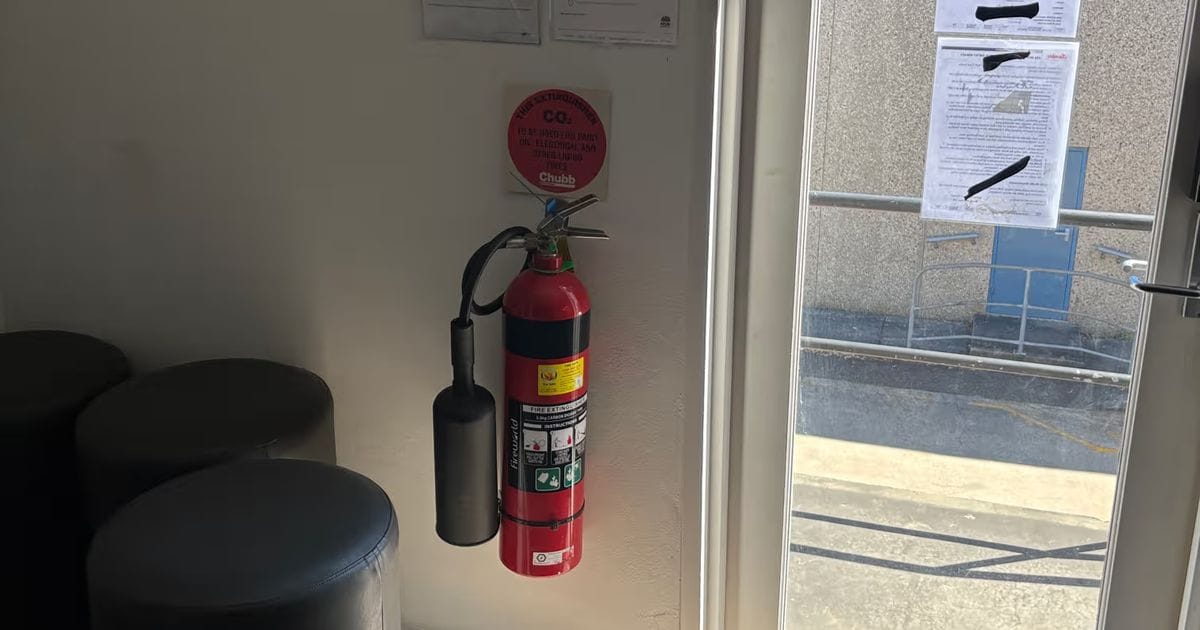
- In the wrong place. Blocked by a filing cabinet, stashed under a desk, moved during a fit-out and never put back.
- The wrong class for the risk. An ABE extinguisher next to a deep fryer in the tea room is not going to help anybody. Class F wet chemical belongs near cooking oils.
- Expired or failed. Six-monthly inspection missed, pressure gauge in the red.
- Signage missing. The extinguisher is there, but the location sign is not, so nobody finds it fast.
Exit and emergency lighting — what we commonly write up
- Faded or dim exit signs. Most are 10-year-rated. Many of the ones we see are older.
- Dead emergency lights that fail the 90-minute battery discharge test.
- Lights blocked by new office partitions, display stands, or mezzanines that went in without anyone thinking about the fire safety side.
- Fittings missing after a ceiling renovation. Taken down, nobody put them back.
Fire doors and smoke doors — what we commonly write up
Fire doors are the ones with a tag on the hinge side and a smoke seal around the frame. Under AS 1905, they must self-close, self-latch, and seal when closed.
- Propped open. With a wedge, a bin, a chair. A propped fire door is not a fire door.
- Hardware missing or modified. Hinges replaced with the wrong type, closers removed, latches that no longer engage.
- Gaps. New flooring was laid and the bottom clearance now exceeds the limit. Or the seals are torn.
- Doors swapped out. A standard door was fitted during a renovation. The fire rating is gone.
If you have no idea which of your doors are rated, that is the first thing to find out. Your Fire Safety Schedule has the list.
Smoke alarms and detection systems — what we commonly write up
Small offices may have residential-style smoke alarms. Larger offices usually have a detection and alarm system tied to a fire indicator panel.
- Smoke alarms past their 10-year replacement date. Every smoke alarm has a 10-year service life. Many in Sydney offices are older than the business lease.
- Detector heads painted over during renovations.
- The fire indicator panel in fault. Nobody notices because nobody looks at the panel.
- No monitoring agreement, or an expired one. The panel sits there, but nothing is calling anyone if it goes off.
The 20-minute walk every office owner should do
Before an inspection, before any renewal, do this yourself:
- Walk to every extinguisher. Can you touch it without moving anything? Pressure gauge green?
- Walk every fire exit. Clear path, door closes, signage lit?
- Walk every fire door. Closed, self-closing, hardware intact?
- Look up at every exit sign and emergency light. All lit?
- Find your fire blanket. Reachable? In-date?
- Look at your fire indicator panel if you have one. Any fault lights?
- Check the hose reels. Anything in front of them?
Twenty minutes. Takes most of the defect list off the page before we even arrive.
Small offices get missed the most
Offices feel safer than warehouses because the risk looks lower. That is partly true. What is not true is that the compliance obligation is lower.
Any Sydney office of any size, with essential fire safety measures on its Fire Safety Schedule, must submit an Annual Fire Safety Statement to Council and Fire & Rescue NSW each year. Missing it is the same consequence for a 10-person consultancy as it is for a 200-person head office.
What we see is owners of smaller offices assuming the statement is someone else’s problem — the landlord’s, the agent’s, the previous owner’s. Twelve months later, council writes to them asking where it is.
What we see go wrong
A Parramatta office we inspected this year had boxes of marketing material and furniture from a recent renovation stacked in front of three separate fire exits. Nothing malicious, just the slow build-up of stuff that happens when nobody is walking the floor with fire safety eyes. We had the owner clear the paths of travel the same day and put a weekly five-minute walk-around on their operations checklist, so it does not creep back in by the next inspection.
One provider across every measure
Most Sydney office owners end up with three or four fire safety contractors. One for extinguishers, another for the fire doors, another for the panel. Each sends their own report, their own invoice, their own schedule.
By the time the AFSS (Annual Fire Safety Statement) deadline arrives, nobody has the full picture and the owner is chasing four providers to get paperwork in.
FireSafe works across every measure on your Fire Safety Schedule from one team, APFS-credentialed, 16 years in Sydney commercial buildings. One contact, one report, one statement.
Send us the address and your Fire Safety Schedule. We will tell you what the building actually needs.
Call 1300 347 372 or request a free office inspection.
Disclaimer: This article is intended for general informational purposes only. It does not constitute legal advice. Building owners, strata committees, office managers, and property managers should seek independent professional advice regarding their specific compliance obligations under the Environmental Planning and Assessment Regulation 2021, AS 1851-2012, the National Construction Code, and any applicable Australian Standards. Fire safety equipment requirements vary depending on building class, size, occupancy, and the specific hazards of the workplace.
Related reading:
Fire Safety Inspections Sydney · Commercial & Industrial Properties · Fire Doors

Written by FireSafe AU. Australian family owned since 2010 and a Silver Member of the Fire Protection Association of Australia. Testing, inspection and maintenance to AS1851-2012 across Sydney.