Most buildings have extinguishers. Far fewer have a servicing programme that would survive being questioned.
The gap is rarely neglect. Extinguishers are the most visible fire measure in a building, so they are the one everyone assumes is handled. A unit on the wall looks identical whether it was serviced in March or three years ago, unless you know what to read.
How often do fire extinguishers need to be tested?
Six-monthly. That is the servicing interval, and it is shorter than the annual fire safety statement, which is why servicing and statement preparation are separate events that fall due at different times.
The shorter cycle exists because an extinguisher is a pressure vessel in a hostile environment. It can lose pressure slowly, corrode internally, have its pin pulled and replaced, or be knocked off its bracket. None of that shows externally.
Some types carry a periodic pressure test on a longer cycle, recorded with the unit’s service history. A unit past its test life is condemned rather than serviced. The table is on our equipment testing frequencies page, and the standard behind it is explained in AS1851-2012 explained.
What actually happens during a service?
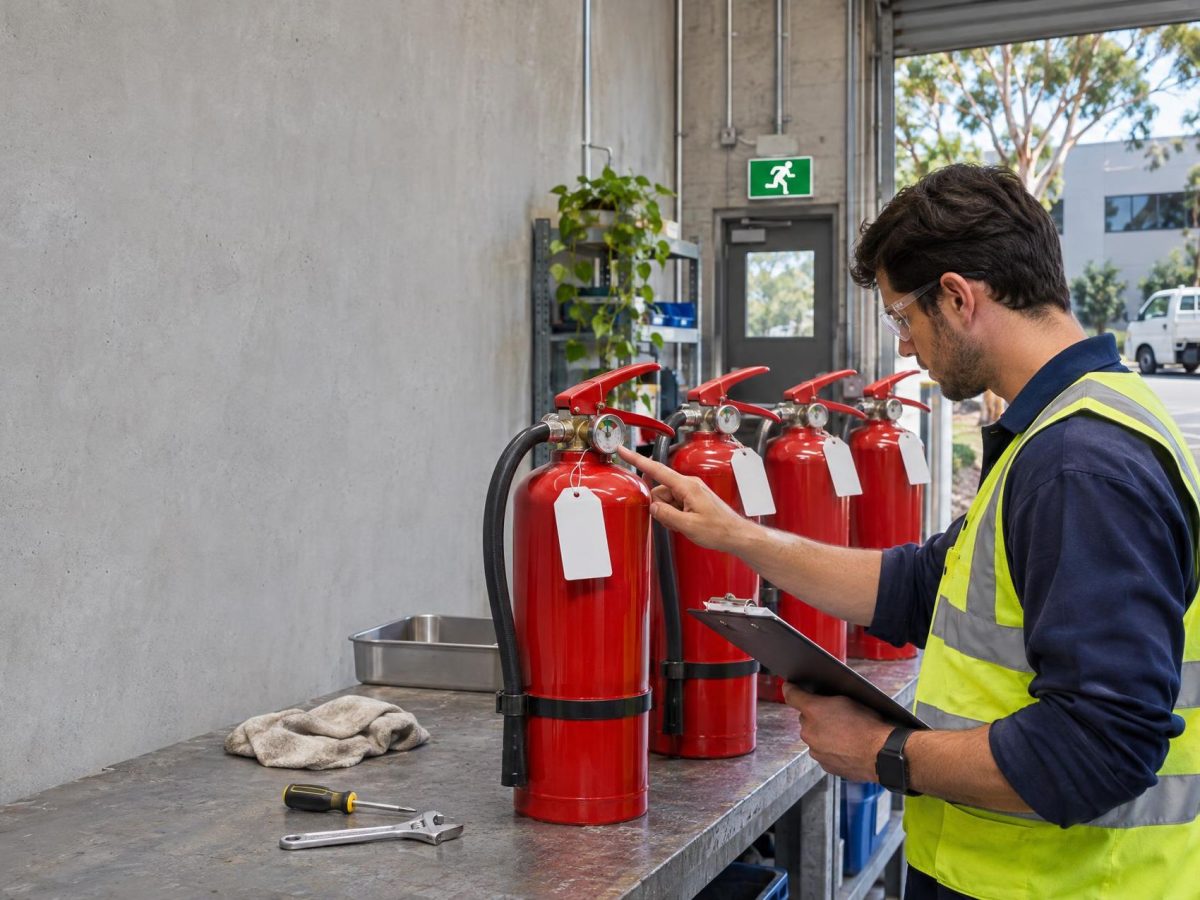
A technician attends, locates every unit on the register, and works through the same sequence for each.
The unit comes off the bracket so body and base can be inspected for corrosion. The gauge is read and pressure confirmed in the operating band. Pin and tamper seal are checked, and the seal replaced. Hose or nozzle is inspected for cracking, blockage or deformation. The service label is updated and the unit returned to its bracket, correctly oriented and signed.
Anything that fails gets flagged in writing rather than noted verbally. That written record is what turns a service into evidence, and it is why every FireSafe attendance produces a report with findings and photographs rather than a year-end summary. How that works is on the fire equipment maintenance and inspection page.
What gets checked, item by item?
Seven things, and a service skipping any of them is not a full service.
Pressure gauge. In band, glass intact, not stuck.
Safety pin and tamper seal. Pin present, seal unbroken. A missing seal means the unit may have been discharged and rehung.
Hose and nozzle. No cracking, blockage or deformation at the swivel.
Body and base. No corrosion, dents or welded repairs. Base corrosion is the most common reason a unit is condemned.
Label and service tag. Present, legible, current. An illegible label is a compliance failure even if the unit works.
Mounting. Correct height, correct bracket, secure, unobstructed.
Signage. The extinguisher sign present and visible from the approach.
Why six-monthly rather than annual?
Because the failure modes are invisible on a walk-past.
A gauge can drift out of band over months. A seal can perish. A pin can be pulled during a minor incident and replaced without being logged, leaving a partly discharged unit that looks full. A bracket can loosen and the unit hang at the wrong angle.
None of that announces itself. A six-monthly cycle catches it before the unit is needed, which is the point of a servicing regime. An annual arrangement gives a failure twelve months to develop.
What about quantity and placement?
Servicing assumes the building has the right units in the right places. If the layout has changed, the count and placement may no longer match what the building needs.
Two existing articles cover that side: how to choose the appropriate fire extinguisher and how many fire extinguishers should we have in an office. A visit that finds a unit in the wrong place is a finding, not a rehang.
When is an extinguisher condemned rather than serviced?
Five situations. Body corroded or dented to where pressure integrity cannot be assured. Gauge failed and the unit cannot be recharged safely. Hose or valve assembly damaged beyond economic replacement. Unit past its pressure test life. Or parts no longer available for that model.
Condemning a unit is not a revenue opportunity, it is the honest answer. A unit that cannot be made safe comes out of service and is recorded as such, and the building then decides whether to replace it or adjust coverage elsewhere.
What records does a building need?
Two layers, and both are asked for at audit.
At the unit. A service tag showing date and technician, updated at every attendance.
At the building. A register listing every unit by location, type and service history, so a missing or relocated unit is visible rather than silently absorbed.
When a council order or insurer asks what has been done, the register answers it. A building relying on tags alone can show that units were serviced, but not that any are missing.
Frequently asked questions
How often should fire extinguishers be tested?
Six-monthly. That interval applies regardless of the annual fire safety statement date, which is a separate obligation.
Does an annual fire safety statement cover extinguisher servicing?
No. The statement is a yearly assessment that scheduled measures perform. Servicing is the ongoing programme that makes the assessment possible.
What is a fire extinguisher pressure test?
A periodic test of the pressure vessel on a longer cycle than routine servicing. Units past their test life are condemned because pressure integrity can no longer be assured.
Can a partially discharged extinguisher be rehung and used?
Only after being recharged by a competent person and the record updated. A unit discharged and rehung without recharge will read in band and deliver nothing useful.
How do I know an extinguisher has been serviced?
Read the tag. It shows the date and who did it. A missing, illegible or stale tag means the unit is out of cycle.
Do all extinguisher types run on the same cycle?
Routine servicing is the same six-monthly cycle across portable types. The longer pressure test varies by type, which is why the register should record type as well as location.
What happens if a unit fails?
It is flagged in writing and either corrected, recharged or condemned. A failure found on a routine visit has runway; the same failure found during statement preparation becomes a disclosure.
Is servicing the same as inspection?
No. Servicing is hands-on maintenance. Inspection is the verification exercise, often for a buyer or incoming agent. The distinction is in fire safety audit, inspection and statement.

Written by FireSafe AU. Australian family owned since 2010 and a Silver Member of the Fire Protection Association of Australia. Testing, inspection and maintenance to AS1851-2012 across Sydney.