The smoke alarm rules most Australians are familiar with are the residential ones: a photoelectric alarm in every bedroom and on every level, hardwired, with battery backup. Commercial buildings work differently. The compliance obligation, the device standard, the installation requirement, and the responsible party all change when you move from a residential dwelling into a commercial premises, and the difference matters for building managers who need to maintain a compliant Annual Fire Safety Statement.
Commercial building managers in NSW regularly underestimate their smoke alarm obligations, particularly in mixed-use buildings, strata complexes with commercial lots, and Class 2 buildings where individual lot requirements differ from common area obligations. Getting this wrong creates a defect on the AFSS and potential Council enforcement exposure.
In this guide, FireSafe AU explains what AS3786 requires for smoke alarms in commercial buildings, how the NCC determines which standard applies to which building class, who holds the compliance obligation, and what the most common gaps are across Sydney. To explore our smoke alarm inspection and maintenance services, visit our smoke alarms page.
When does the NCC require smoke alarms in commercial buildings?
The NCC uses building class to determine which fire detection approach applies. Smoke alarms under AS3786, which are standalone self-sounding devices, are primarily required in:
- Class 2 buildings (apartments): in each sole-occupancy unit including bedrooms and corridors within the unit, and in required common areas
- Class 3 buildings (hotels, serviced apartments, boarding houses): in each guest room and relevant common areas
- Class 4 parts (a dwelling within a Class 5, 6, 7, 8, or 9 building): the dwelling portion is subject to residential-equivalent smoke alarm requirements
For Class 5, 6, 7, 8, and 9 buildings (offices, retail, industrial, healthcare, and educational), the NCC typically requires a networked fire detection and alarm system under AS1670.1 rather than standalone smoke alarms. Where a networked system is required, standalone smoke alarms do not satisfy the obligation regardless of how many are installed.
What does AS3786 require for smoke alarms in commercial applications?
AS3786 is the Australian Standard for smoke alarms. Key requirements relevant to commercial building managers:
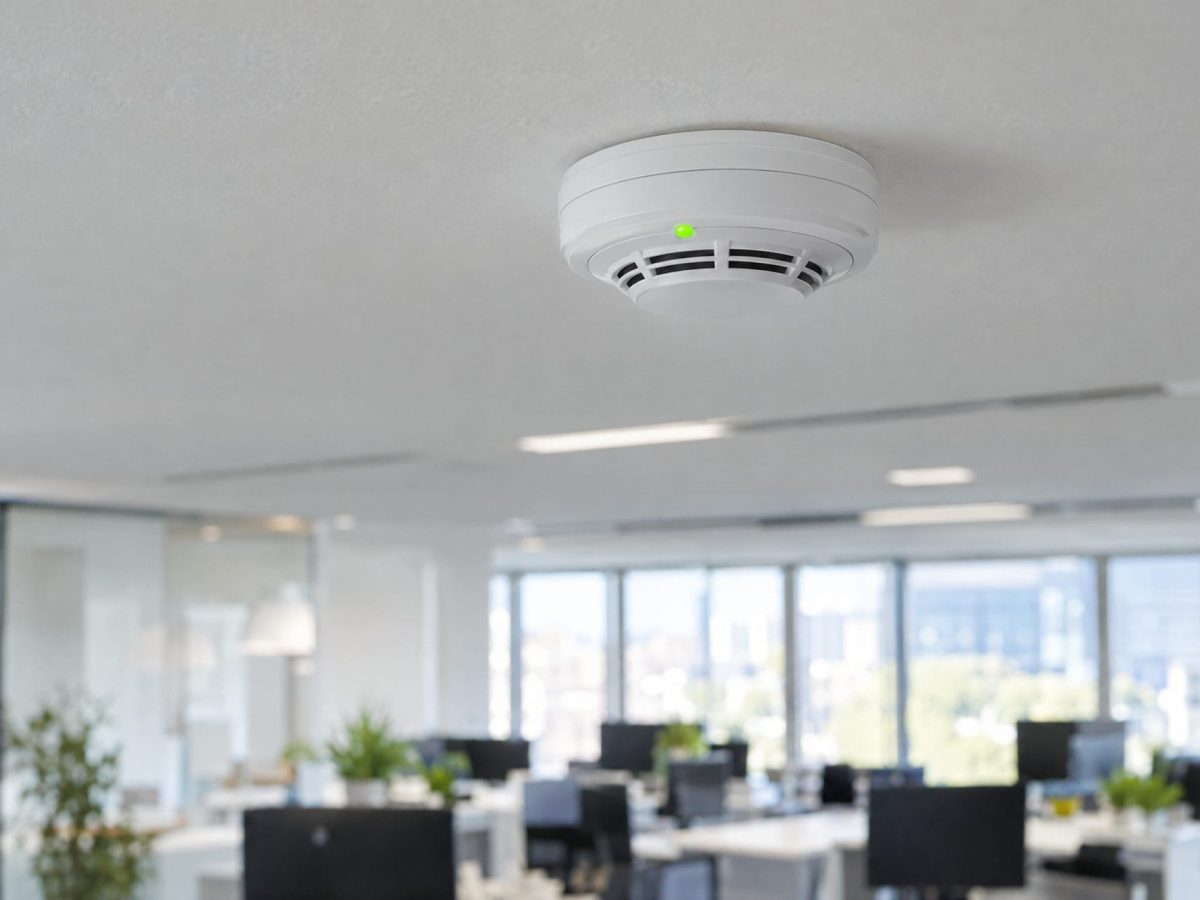
Photoelectric technology: Photoelectric alarms are preferred in most commercial and residential applications. They are more effective at detecting slow-burning smouldering fires and less prone to nuisance activations from cooking fumes and steam than ionisation alarms. In NSW, photoelectric alarms are now mandatory in residential buildings. The preference for photoelectric technology carries across to commercial applications where standalone alarms are the correct device for the building class.
Interconnection: Where multiple smoke alarms are required in a building or unit, they must be interconnected so that when one activates, all activate simultaneously. Interconnection can be hardwired or, in certain applications, wireless. An un-interconnected alarm in a common corridor that cannot be heard from a bedroom at the far end of a unit is not a compliant installation.
Power supply: Smoke alarms in commercial applications requiring permanent installation must be hardwired to the building’s electrical supply with battery backup. Battery-only devices are not compliant for permanent commercial installation.
Placement: AS3786 specifies minimum placement requirements including ceiling mounting, minimum distance from walls and corners, and exclusion zones near air conditioning outlets and kitchen appliances. Our smoke alarms service page provides additional detail on placement requirements across different room types.
Who is responsible for smoke alarm compliance in commercial buildings?
In most commercial settings, the building owner holds the obligation for common area smoke alarms and any alarm that is an essential fire safety measure. In strata buildings:
- The owners corporation is responsible for smoke alarms in common areas
- In Class 2 buildings, individual lot owners are responsible for smoke alarms within their own lots
- In commercial strata lots, the lot owner is responsible for devices within their tenancy; the owners corporation covers common areas
Tenants are not responsible for installing compliant hardwired smoke alarms unless the lease specifically assigns that obligation. Tenants are responsible for not disabling or removing alarms installed by the owner. For a broader understanding of who is responsible for each essential fire safety measure in your building, see our fire safety inspections overview.
What are the most common smoke alarm compliance gaps in Sydney commercial buildings?
- Wrong device type for the building class. Standalone battery-operated smoke alarms installed in a Class 5 or 6 building that requires a networked detection system. These alarms look like compliance and are not. A building with this arrangement cannot certify that essential fire safety measure as compliant.
- Ionisation alarms not replaced with photoelectric. Older buildings with ionisation alarms that have not been upgraded. Where replacement is triggered by the building’s fire safety schedule, photoelectric is the required technology.
- Alarms not interconnected. Multiple alarms installed but not wired together. In a long corridor or multi-room commercial tenancy, a non-interconnected alarm in one location does not alert occupants in another part of the premises.
- Battery backup expired or dead. Hardwired alarms with dead backup batteries power normally from the mains but have no protection if mains power fails during a fire. Backup battery condition must be tested at each service.
- Placement compromised by fit-out works. Ceiling modifications during a tenancy fit-out leave smoke alarms positioned directly adjacent to air conditioning outlets or inside zones where new partitions obstruct coverage. Correct placement at original installation does not remain correct indefinitely when buildings are modified.
- End-of-life alarms not replaced. Every smoke alarm has a service life of 10 years from the date of manufacture printed on the device. Alarms that have passed this date are non-compliant under AS1851 regardless of whether they still respond to a test button press.
FireSafe AU inspects and maintains smoke alarms across Sydney commercial and strata buildings. Contact our team to arrange a compliance assessment.
Book Your Smoke Alarm Compliance Assessment With FireSafe AU
FireSafe AU carries out smoke alarm inspections and fire safety assessments across Sydney for commercial, strata, and mixed-use buildings. Our technicians confirm installed devices are the correct type for the building class, that interconnection and power supply requirements are met, and that placement complies with AS3786. To book a service or learn more about what we cover, visit our smoke alarms page or contact us directly.
Frequently Asked Questions: Smoke Alarms in Commercial Buildings NSW
Do I need smoke alarms or a networked smoke detection system in my commercial building?
This depends on your building class and size. Class 5, 6, 7, 8, and 9 buildings generally require a networked system under AS1670.1 rather than standalone alarms. Class 2 and 3 buildings and Class 4 parts require standalone smoke alarms under AS3786 in specified locations. A fire safety assessment confirms which requirement applies to your specific building.
Are ionisation smoke alarms still compliant in commercial buildings in NSW?
In residential buildings, photoelectric alarms are now mandatory and ionisation alarms must be replaced. In commercial buildings the position depends on what the building’s fire safety schedule specifies and when devices were last certified. Where replacement is triggered, photoelectric is the required standard.
How often do commercial smoke alarms need to be tested?
Under AS1851, smoke alarms that are listed essential fire safety measures must be tested at the intervals the standard prescribes. For most commercial smoke alarms this involves annual inspection and testing with battery backup confirmed at each service.
Who replaces smoke alarms at end of life in a commercial building?
The building owner for common area alarms. In strata buildings the owners corporation covers common areas. Individual lot owners are responsible for devices within their own lots. Smoke alarms must be replaced at or before 10 years from the manufacture date.
Can a tenant remove a smoke alarm to stop nuisance activations?
No. Removing or disabling a smoke alarm is an offence in NSW. The correct response is to notify the building manager and arrange for a qualified technician to assess and correct the cause of the nuisance activation.

Written by FireSafe AU. Australian family owned since 2010 and a Silver Member of the Fire Protection Association of Australia. Testing, inspection and maintenance to AS1851-2012 across Sydney.