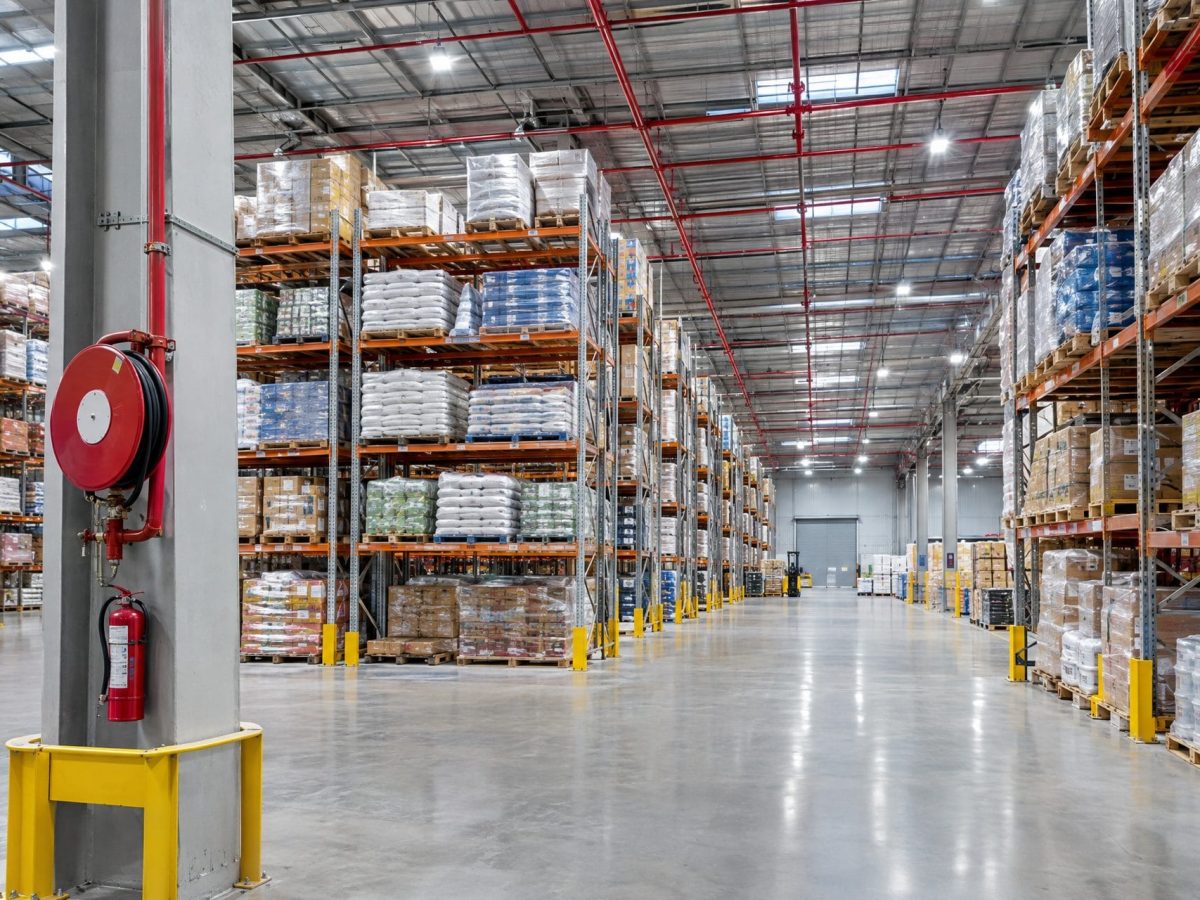
Walk through most Sydney warehouses and you will find fire extinguishers mounted near the exit doors, a hose reel cabinet somewhere near the loading dock, and an exit sign above the roller door. What you will not always find is a clear understanding of what makes warehouse and industrial fire protection fundamentally different from a commercial office or retail premises, and what AS1851 actually requires for a facility of this type and size.
The fire risk profile of a warehouse is driven by factors that do not exist in most other commercial building types: the fuel load concentrated in racking, the ceiling heights that allow fire to develop freely before any suppression system responds, and the nature of the stored goods. A warehouse storing flammable liquids or dangerous goods is in an entirely different compliance category from a warehouse storing general merchandise, and the fire protection obligations reflect that.
In this guide, FireSafe AU explains what makes industrial building fire protection distinctive, how rack storage changes the fire engineering equation, what AS1851 maintenance covers for warehouse systems, and the specific obligations for dangerous goods storage. For a full overview of maintenance obligations across all building types, see our fire safety inspections guide.
What makes warehouse and industrial fire protection different from standard commercial buildings?
In a Class 5 office building or a Class 6 retail shop, fire starts at a relatively low level, generates convective heat that rises to activate ceiling-level sprinkler heads, and the sprinkler suppresses the fire before it spreads significantly. The design of the sprinkler system, the placement of detection equipment, and the fire resistance of the structure are all calibrated for this predictable fire development pattern.
In a warehouse, three factors change that equation:
Fuel concentration in racking. Goods stored in dense vertical racking create channels that accelerate fire spread upward. A fire starting at floor level in a conventional warehouse grows differently from the same fire in a high-bay racking system, where the rack channels create a vertical chimney effect that drives the fire upward faster than ceiling sprinklers were designed to respond.
High clearances. Ceiling heights of 8, 10, or 12 metres mean that heat must travel a long vertical distance before activating ceiling-level sprinklers. During that travel time, the fire is developing and spreading at floor and rack level without any suppression response.
Variable stored goods. The fire load in a warehouse changes with every shipment. Flammable packaging materials, aerosol products, and chemicals stored above threshold quantities require specific fire engineering responses that a standard warehouse fit-out does not provide.
How does rack storage change the fire protection requirement?
The problem with high-bay rack storage and standard ceiling-level sprinklers is specific: by the time ceiling-level heat sensors activate and a sprinkler head opens, the fire has already developed vertically through the rack structure. The water discharge from a ceiling-level head must penetrate through multiple rack levels, past stored goods and packaging, to reach the fire at lower rack levels. In a high-density racking configuration, ceiling sprinkler water often cannot reach the fire source before the blaze has grown beyond what the system can control.
The engineering solution is in-rack sprinklers: sprinkler heads positioned within the rack structure itself at intermediate height levels, designed to discharge water directly onto a fire at the level where it originates. In-rack sprinkler design is governed by AS2118.6 and the specific head placement depends on the rack configuration, the goods being stored, and the ceiling height.
For building managers, the critical practical implication is this: if you modify your rack configuration after the in-rack sprinkler system was designed and commissioned, you may have invalidated the coverage geometry. Increasing rack height, adding rack levels, reconfiguring aisle widths, or changing the category of goods stored in a zone are all changes that require reassessment before the modified configuration is put into operation. This is the same principle that applies to fire door modifications: changes to a certified assembly require reassessment of that assembly’s compliance.
What does AS1851 require for warehouse fire protection systems?
The AS1851 maintenance programme for a warehouse covers all listed essential fire safety measures. For a typical Class 7b or Class 8 industrial building in Sydney:
Automatic fire sprinkler system under AS2118: Monthly visual checks of all sprinkler heads for damage, obstruction, and clearance to stored goods. Quarterly hydraulic flow tests. Six-monthly and annual inspections covering all components including in-rack heads where installed. The clearance distance between sprinkler heads and stored goods is a specific inspection item: goods stacked too close to a sprinkler head deflect the water pattern and reduce suppression effectiveness. For detail on sprinkler types and commissioning, see our fire sprinkler installation guide.
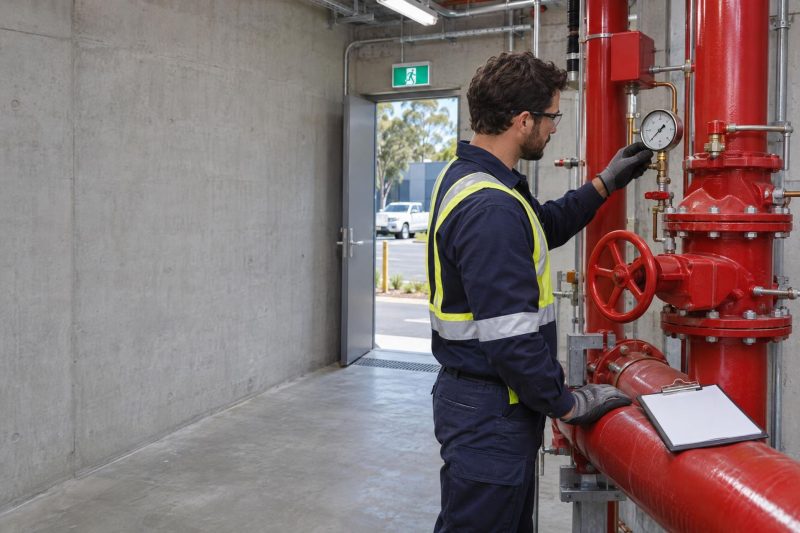
Fire hydrant and pump set under AS2419: Quarterly pump run tests confirming the pump starts and produces pressure. Annual full-flow tests measuring actual flow and pressure at hydrant outlets against the pump’s rated performance. Pump sets that pass the run test but fail the full-flow test are a common finding in older Sydney warehouses.
Fire hose reels: Quarterly operational checks and annual hydraulic pressure tests. Reel placement must ensure every point in the building is within the effective reach of a hose reel. See our products and services page for detail on hose reel maintenance services.
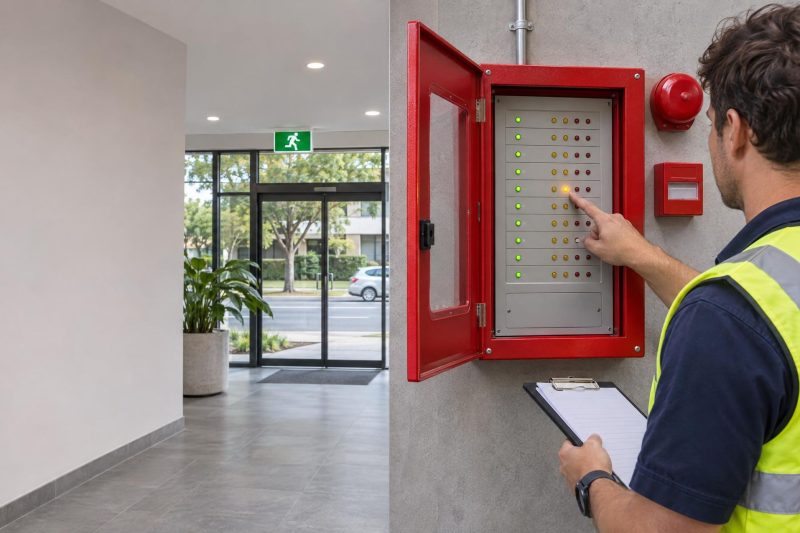
Fire detection and alarm system under AS1670: Detection in warehouses typically uses heat detectors rather than smoke detectors, because the dust, particulate, and temperature variation in a warehouse environment generates unacceptable nuisance activation rates from smoke-type detectors. Monthly, quarterly, and annual testing of all detection devices and the fire indicator panel.
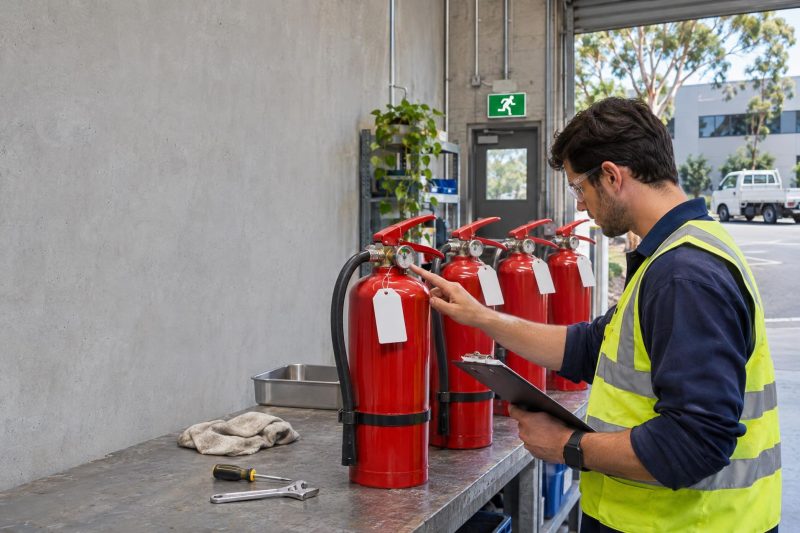
Portable fire extinguishers: Six-monthly and annual inspections. Extinguisher type must match the fire risk in each zone of the building.
Emergency lighting and exit signs: Six-monthly and annual inspections. For detail on testing obligations, see our emergency lighting testing guide.
What are the fire protection obligations for dangerous goods storage?
Dangerous goods storage introduces obligations that go beyond the standard warehouse requirements. The framework in NSW includes the Dangerous Goods (Road and Rail Transport) Act 2008, the Work Health and Safety Regulation 2017, and Australian Standards for each dangerous goods class.
Class 3 flammable liquids: Storage above specified threshold quantities requires a dedicated flammable liquid store with fire-rated construction, mechanical ventilation, intrinsically safe electrical equipment, and a suppression system appropriate for the specific liquid class and storage quantity.
Aerosols: High-density aerosol storage presents an explosion risk in addition to the fire risk. The fire engineering for aerosol storage requires higher sprinkler discharge density than general goods, designed to address the explosive pressure release from aerosol cans involved in a fire.
Flammable gases: Compressed gas cylinder storage requires specific ventilation, physical segregation from ignition sources, and proximity assessment relative to the building’s fire protection systems.
A warehouse storing dangerous goods in quantities above the threshold specified in the WHS Regulation must hold a current dangerous goods licence from SafeWork NSW. The licence conditions typically include fire protection requirements that must be maintained concurrently with the AS1851 programme. Contact FireSafe AU to discuss how these obligations interact with your current maintenance programme.
What is a deluge system and when is it required in a Sydney warehouse?
A deluge system is a suppression installation in which all the sprinkler heads in a protected zone are permanently open. Unlike a standard sprinkler system where individual heads activate when they reach their rated temperature, a deluge zone activates simultaneously across every head when the control valve opens in response to a detection signal.
Deluge systems are used in high-hazard areas where a fire is expected to develop so rapidly that the sequential activation of individual heads would not control it in time. In Sydney warehouse and industrial settings, common applications include flammable liquid storage and processing areas, vehicle maintenance workshops with significant fuel loads, transformer enclosures, and chemical processing areas with specific suppression requirements.
The deluge valve, the detection system that triggers it, and the water supply delivering to the open heads all require regular inspection and testing under AS1851. Deluge valve testing is particularly important because these valves are normally held closed under pressure and are triggered only during a real event or a deliberate test. A valve that has not been tested may fail to open when the detection signal is received.
FireSafe AU provides fire protection maintenance programmes for warehouses and industrial buildings across Sydney. Contact our team to arrange an industrial fire protection assessment.
Book Your Industrial Fire Protection Assessment With FireSafe AU
FireSafe AU provides essential fire safety measure maintenance programmes for Class 7b and Class 8 warehouses, industrial facilities, and logistics centres across Sydney. Our technicians are experienced with the specific requirements of warehouse environments, including in-rack sprinkler systems, dangerous goods storage areas, deluge systems, and large-footprint hydrant networks.
We provide full written reports after every inspection, structured to support Annual Fire Safety Statement lodgement, and we carry out rectification works where defects are identified. View our full range of fire protection services or contact FireSafe AU today to arrange your industrial fire protection assessment.
Frequently Asked Questions: Fire Protection for Warehouses and Industrial Buildings Sydney
Do all Sydney warehouses need an automatic sprinkler system?
Not all, but many do. The NCC requires sprinkler systems in Class 8 buildings above specified floor areas, in buildings storing dangerous goods above threshold quantities, and where the fire load or occupancy requires it. A fire safety assessment of your specific building confirms whether a sprinkler system is required.
How does increasing rack height affect my sprinkler system compliance?
The in-rack or ceiling sprinkler system design is specific to the rack configuration at the time of commissioning. Increasing rack heights or adding rack levels changes the coverage geometry and may invalidate existing head positions. A fire engineering assessment before making changes is strongly recommended.
What is the difference between a deluge system and a standard sprinkler system?
In a standard system, individual heads activate when they detect heat. In a deluge system, all heads in the zone are permanently open and the entire zone activates simultaneously when the deluge valve opens. Deluge systems are used where rapid zone-wide suppression is required from the first moment of detection.
What extinguisher type is required for a warehouse storing flammable liquids?
Class B fire extinguishers, typically dry chemical powder or foam, are required for flammable liquid hazards. The specific type, capacity, and placement spacing depends on the quantity and class of liquid stored and must be determined by a competent fire safety practitioner.
How often must a fire hydrant pump set be tested in a warehouse?
Under AS1851, fire pump sets require a quarterly run test and an annual full-flow performance test. The annual full-flow test is the definitive test of pump performance and is the one most likely to identify degraded pump output before it becomes a critical failure in a real fire event.

Written by FireSafe AU. Australian family owned since 2010 and a Silver Member of the Fire Protection Association of Australia. Testing, inspection and maintenance to AS1851-2012 across Sydney.